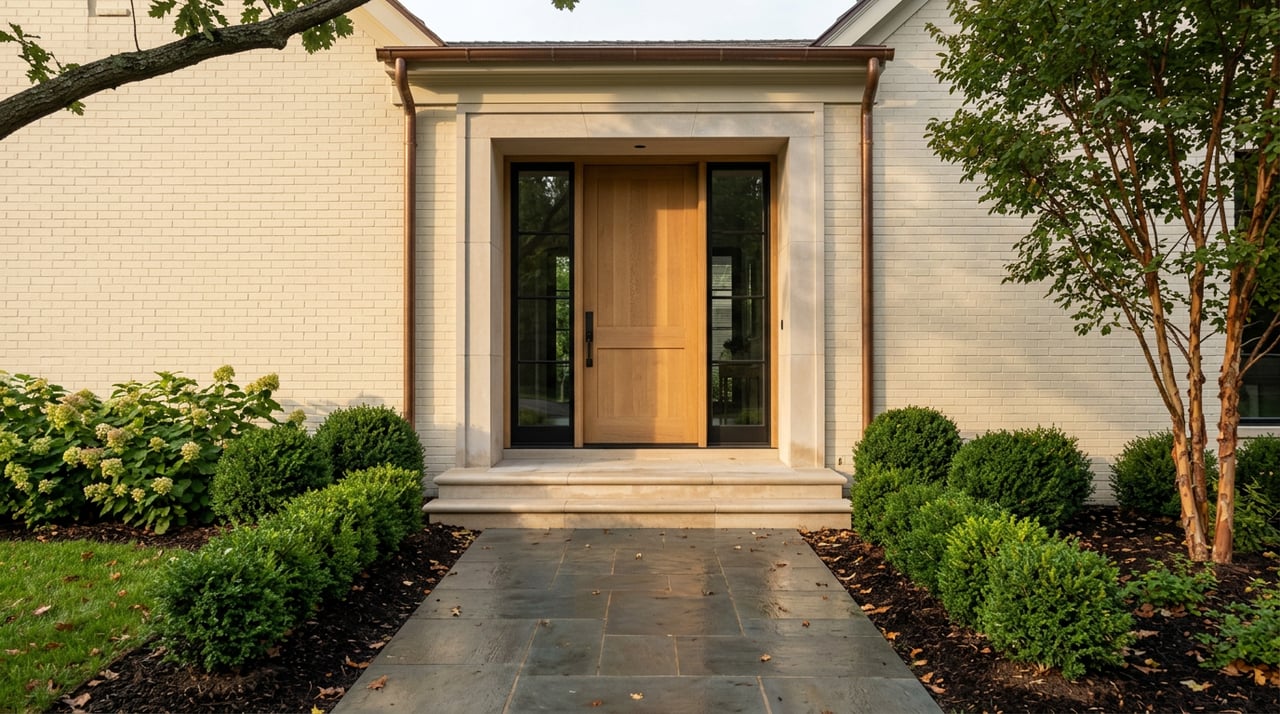
The Bloomfield Hills City Line: What Your Address Actually Tells You
September 10, 2026
September 10, 2026
Two houses come up on the same search. Both say Bloomfield Hills. They are a few minutes apart, similar acreage, similar vintage, similar money. One of them sits inside the City of Bloomfield Hills. The other sits in Bloomfield Township, which surrounds it. Nothing on the listing announces which is which, and the buyer touring both has no reason to ask.
That line decides more than the return address. It decides who arrives when you call 911, whether the street will ever get a paved path and who pays for it, and whether the house treats its own wastewater in the back yard. The last one is the item that most often surfaces late, during inspections, when leverage has already been spent.
Michigan is the only state without a statewide sanitary code. Standards for wells and on-site septic systems are set locally, which is why some Michigan communities have adopted time-of-sale or time-of-transfer ordinances requiring a well and septic evaluation before a property changes hands, and others have not. Neighboring West Bloomfield Township runs a Time of Sale septic program. In the City of Bloomfield Hills and in Bloomfield Township, no comparable program turned up. The evaluation happens because the purchase agreement says it happens.
This is not a fringe concern in a market of estate lots. Oakland County has more than 80,000 on-site sewage disposal systems on residential and commercial properties, and since May 2012 the county has licensed anyone who installs, alters, or repairs one under Article XI of its sanitary code. The City of Bloomfield Hills publishes its own homeowner guidance on on-site systems, and the failure signals it lists are the ones a buyer walking a property in September could plausibly see and misread: pooling water or muddy soil near the system, a slow backup when the laundry runs, a bright green stripe of grass across the lawn, an odor in the back yard. The city directs residents to the Oakland County Health Division at 248-858-1280 for a contractor list.
A green stripe in a lawn reads as good irrigation to a buyer from a sewered suburb. On a septic lot it can read as a drain field pushing effluent toward the surface. The difference between those two readings is a five-figure conversation, and in this market it belongs in the offer, not in the walk-through.
Meanwhile, the city's sewered blocks carry their own footnote. The City of Bloomfield Hills is under federal and state mandates to inspect and rehabilitate its local sanitary sewer, and has partnered with Hubbell, Roth and Clark and Liquiforce to do it, with crews working not only in the streets but in backyard easement areas. Sewer service and an unobstructed rear yard are not the same promise. If a seller has built a pool house, a run of hedging, or a sport court over an easement, that is a title and access question worth asking before closing, not after a crew knocks.
In 1932, five square miles of Bloomfield Township were incorporated as the City of Bloomfield Hills. The township continued around it, and later gave up more territory to Birmingham and Pontiac. Today the city and the surrounding charter township together hold roughly 50,000 residents, the overwhelming majority of them on the township side of a boundary that the post office never bothered to dramatize.
That is the whole mechanism. A mailing address organizes mail. A municipal boundary organizes services, capital budgets, and the assessments that pay for them. When those two things stop matching, the listing portals inherit the mailing address and quietly average two jurisdictions into one number.
| Item | City of Bloomfield Hills | Bloomfield Township |
|---|---|---|
| Emergency response | Single Department of Public Safety, cross-trained police, fire, and medical first responders | Separate police and fire departments |
| Pedestrian paths | Effectively none on secondary streets; expansion would require a special assessment district | Existing safety paths, with a township sidewalk plan estimated around $15.8 million in 2025 |
| Wastewater | Municipal sanitary sewer on much of the city, on-site septic on some properties | Municipal sewer in served areas, on-site septic elsewhere |
| Drinking water | Purchased from SOCWA, which purchases from GLWA | Purchased from SOCWA, which purchases from GLWA |
The public safety column is the one buyers underestimate. In the mid-1970s the city replaced separate police and fire departments with a single cross-trained department, a structure it still runs today with 24 full-time sworn personnel working 24-hour shifts alongside full-time and part-time dispatchers. In 2018 the department became a Michigan Association of Chiefs of Police accredited agency and received an Insurance Service Office public protection classification of 3 out of 10, which the city describes as one of only three among Michigan's 31 true public safety departments to hold that rating. An ISO class is not a marketing statistic. It is an input carriers use when they rate a property, which makes it one of the few municipal facts that shows up on a homeowner's annual bill rather than in a brochure.
The path column is the one that costs money later. Reporting in Downtown Newsmagazine's fall 2025 coverage of the Bloomfield Hills City Commission race captured the arithmetic plainly: candidates argued that paths on secondary city streets have limited utility and high cost, that any expansion would require a special assessment district because no funds are currently allocated for it, and that Bloomfield Township's own sidewalk plan carried an estimate around $15.8 million. In a five-square-mile city, a small number of households absorb the cost of anything large. That is also why the city's Fiscal Years 2026 to 2030 Capital Improvement Plan reads like a household ledger, down to rehabilitating twin culverts on Chesterfield Road and replacing rooftop HVAC units at a public safety building constructed in 2000.
Read those two facts together and you get the practical translation for a buyer: inside the city, walkability is a street-by-street condition rather than a municipal amenity, and any future path is a cost that attaches to the parcel you just bought.
The water column, by contrast, is where a suspected difference disappears. Both the city and the township purchase water from the Southeastern Oakland County Water Authority, which purchases from the Great Lakes Water Authority. Oakland County's Water Resources Commissioner has been involved with the Bloomfield Hills system since 1963, reports no known lead service lines in that system, notes that county standards have required copper for small-diameter service lines since 1957, and describes three pressure districts where pressure depends on elevation. For an estate lot with substantial irrigation, the pressure district is a more useful question than the municipality.
Ask a national data service what taxes look like in Bloomfield Hills and you get one figure covering several ZIP codes. As of 2026, one such service estimated a median annual bill near $3,576 in 48304 and near $4,802 in 48301, attributing the spread primarily to school district levies and local assessment districts rather than to the houses themselves. The Bloomfield Hills name spans more than one school district as well; both Bloomfield Hills Schools and Birmingham Schools serve portions of this area, and each carries its own levy.
So the "Bloomfield Hills median" a buyer reads on a portal is a blend of two municipal governments, multiple ZIP codes, multiple school levies, sewered blocks and septic lots, streets with safety paths and streets without. It is an accurate average of things that do not belong in the same average. Sellers feel the same distortion in reverse when a home is compared against sales that carried a different levy and a different service package.
Does a Bloomfield Hills mailing address mean the home is in the City of Bloomfield Hills? No. The city covers roughly five square miles carved out of Bloomfield Township in 1932. A large share of homes with a Bloomfield Hills address sit in the township, with a different municipal government, different departments, and a different tax bill.
Is a septic inspection required when a home here sells? Not by ordinance that I have found in either the city or the township. Michigan has no statewide sanitary code, so time-of-sale requirements are local, and nearby communities differ. Treat the evaluation as a negotiated contingency you request, not a step that happens automatically.
Who provides emergency services inside the city? The city runs a single Department of Public Safety with cross-trained police officers, firefighters, and medical first responders. The township maintains separate police and fire departments.
If you are comparing two Bloomfield Hills addresses this fall, the useful work happens before the offer: confirming the jurisdiction, the wastewater system, and the easements attached to the parcel. Erin Keating DeWald walks that checklist with buyers and sellers across Bloomfield Hills, Bloomfield Township, and Birmingham. Let's Connect.
Stay up to date on the latest real estate trends.

Partner with a trusted Birmingham real estate expert known for hands-on service and exceptional outcomes.