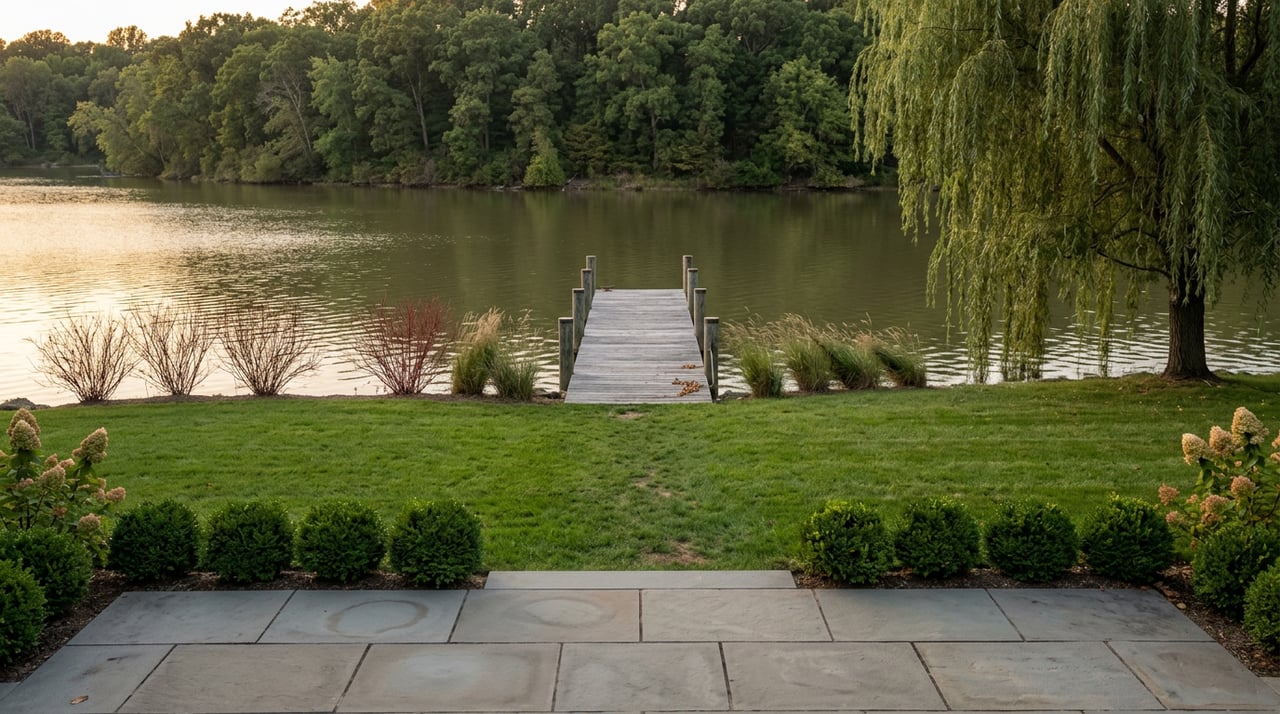
Bloomfield Township Lake Privileges vs Lakefront Rights
August 20, 2026
August 20, 2026
Two colonials go up for sale within three weeks of each other in Bloomfield Township. Same era of construction, same square footage, same finishes down to the quartz counters. One is listed at $950,000 and calls itself "lakefront." The other sits two doors down, lists at $1.15 million, and calls itself "lake privileges." A buyer working off square footage and school district alone would expect the cheaper house to be the better deal. It might be. Or the $200,000 gap might be the most rational pricing decision either seller made, because the two words on those listings describe two entirely different bundles of legal rights, not two different views.
Bloomfield Township's township-wide numbers don't show you this split. As of July 2026, homes here listed at a median of $812,000, running about $204 a square foot. That figure is a blend of roughly 31 named lakes scattered across the township, almost all of them private, most of them small enough to fit in a subdivision's back pocket, and only a handful large enough and unrestricted enough to be called all-sports. When a buyer compares that township median against Birmingham or Bloomfield Hills pricing and tries to draw a straight line, they're comparing a number that hides three separate property-rights tiers inside itself.
Michigan law draws a hard line that most listing photos don't. Bloomfield Township's own environmental services department defines a riparian owner as someone whose land actually touches the water, and it specifies that riparian rights are property rights which run with the land and include access and reasonable use of the water. That phrase, "run with the land," is the entire ballgame.
"Lake privileges" is a different animal. Tilchin & Hall puts it plainly in a recent client guide: phrases like private access, lake privileges, and deeded access can mean very different things. That distinction showed up in a Michigan Supreme Court case decided right here in Bloomfield Township, where a developer converted apartments into condos, built a small dock off a shared easement, and advertised the units as carrying lake-access rights, only to end up in litigation with the township over who was actually entitled to use that water.
The third tier is simpler and easier to miss: a subdivision name includes the name of a lake. The name alone did the marketing.
The lakes also differ in size and how they connect. Forest Lake, a private 40-acre lake with a gated community and a golf course among its waterfront homes, connects by canal to Lower Long Lake, a 190-acre lake, which in turn connects to Upper Long Lake, a 130-acre lake reachable by boat through that same canal system.
Smaller, quieter lakes carry their own version of this specificity. Gilbert Lake, a private 63-acre lake just north of Quarton Road and east of Telegraph, holds roughly 45 homes along 1.8 miles of shoreline, tops out at 18 feet deep, and averages under 6 feet. It feeds into a tributary of the Rouge River. Wing Lake and Sodon Lake sit nearby, small enough that most buyers cross-shopping Birmingham's walkable core have never heard of them.
The same Michigan law firm's guidance is direct about where buyers get burned: before moving forward on a waterfront purchase, have an attorney review the title and a survey to confirm the property is truly riparian, and read the actual deed or association bylaws, because without them it's impossible to know what you're buying. That's not caution for its own sake. A subdivision's lake-privilege documents can spell out whether a dock is included, waitlisted, seasonal only, or shared among a rotating list of owners who take turns. None of that shows up in a listing description, and very little of it shows up in a home inspection.
There's a second layer worth checking before anyone gets attached to a specific address: lot lines under water are not always where they look. Kuhn Rogers explains that Michigan uses a thread-line or pie-slice method to determine where one riparian owner's underwater boundary ends and the next one's begins, and disputes over those lines are common enough that a staked survey before closing is standard advice among agents who work these lakes regularly. A homeowner who assumes their frontage runs straight out from their yard can be wrong about where their legal water rights actually stop.
| Water Body | Notable Detail |
|---|---|
| Upper Long Lake | Connects by canal to Lower Long Lake |
| Lower Long Lake | 190 acres, feeds into Forest Lake |
| Forest Lake | 40 acres, golf course frontage |
| Square Lake | Cited across multiple township sources |
| Gilbert Lake | 63 acres, roughly 45 homes, off Quarton Road |
None of this means Bloomfield Township's $812,000 median is wrong. It means the number is doing the job of an average across a market that isn't uniform underneath it. A buyer comparing that figure against Bloomfield Hills or Birmingham pricing should ask which tier of that median they're actually shopping. An off-lake colonial a half mile from Telegraph Road is a different product than a waterfront parcel on Gilbert Lake, which is a different product again from a deeded lake-privilege lot on a subdivision that shares a single dock among a dozen households. Treating all three as interchangeable because they carry the same square footage is how a buyer either overpays for a name on a subdivision sign or underbids on a house whose water rights are worth exactly what the seller is asking.
The fix isn't complicated, but it does take someone who knows the access details around these thirty-one lakes and who reads the association documents before an offer gets written, not after.
Is a survey really necessary if the listing already says "lakefront"? Yes. Underwater lot lines on Michigan's inland lakes follow a thread-line method rather than a straight extension from the shore, and disputes over exactly where one owner's rights end and the next one's begin are common enough that a staked survey before closing is standard practice on these transactions.
If you're comparing Bloomfield Township against Birmingham or Bloomfield Hills and trying to figure out what a specific address actually carries in water rights, Erin Keating DeWald can pull the association documents and survey history before you write an offer, not after.
This article is general information, not legal, tax or financial advice. Consult a qualified professional about your situation.
Stay up to date on the latest real estate trends.
Partner with a trusted Birmingham real estate expert known for hands-on service and exceptional outcomes.